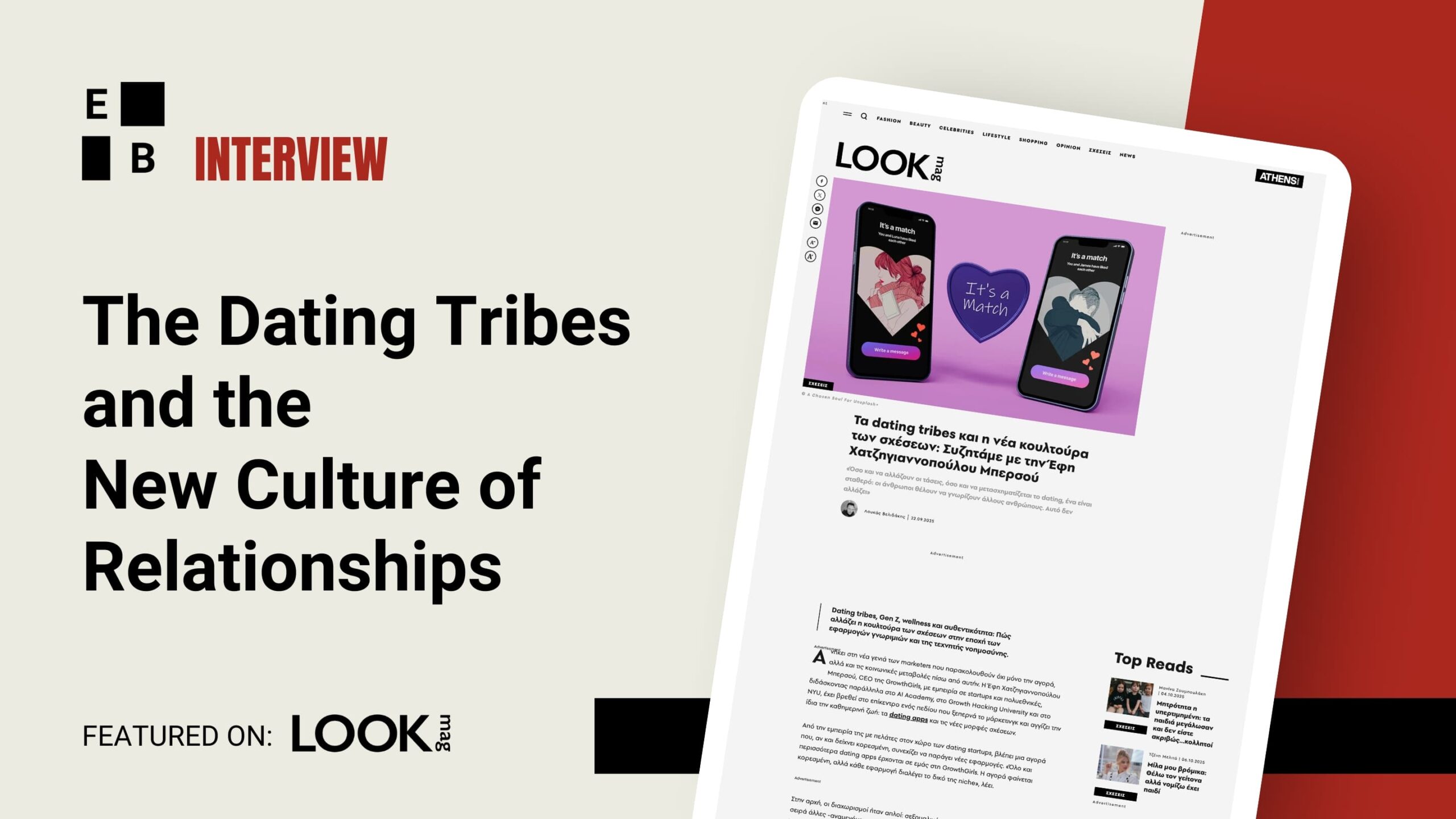
The Dating Tribes and the New Culture of Relationships
Dating apps are no longer just about love, they’re a reflection of how we connect, express, and even brand ourselves. In my conversation with LOOK Mag, I explored how Gen…

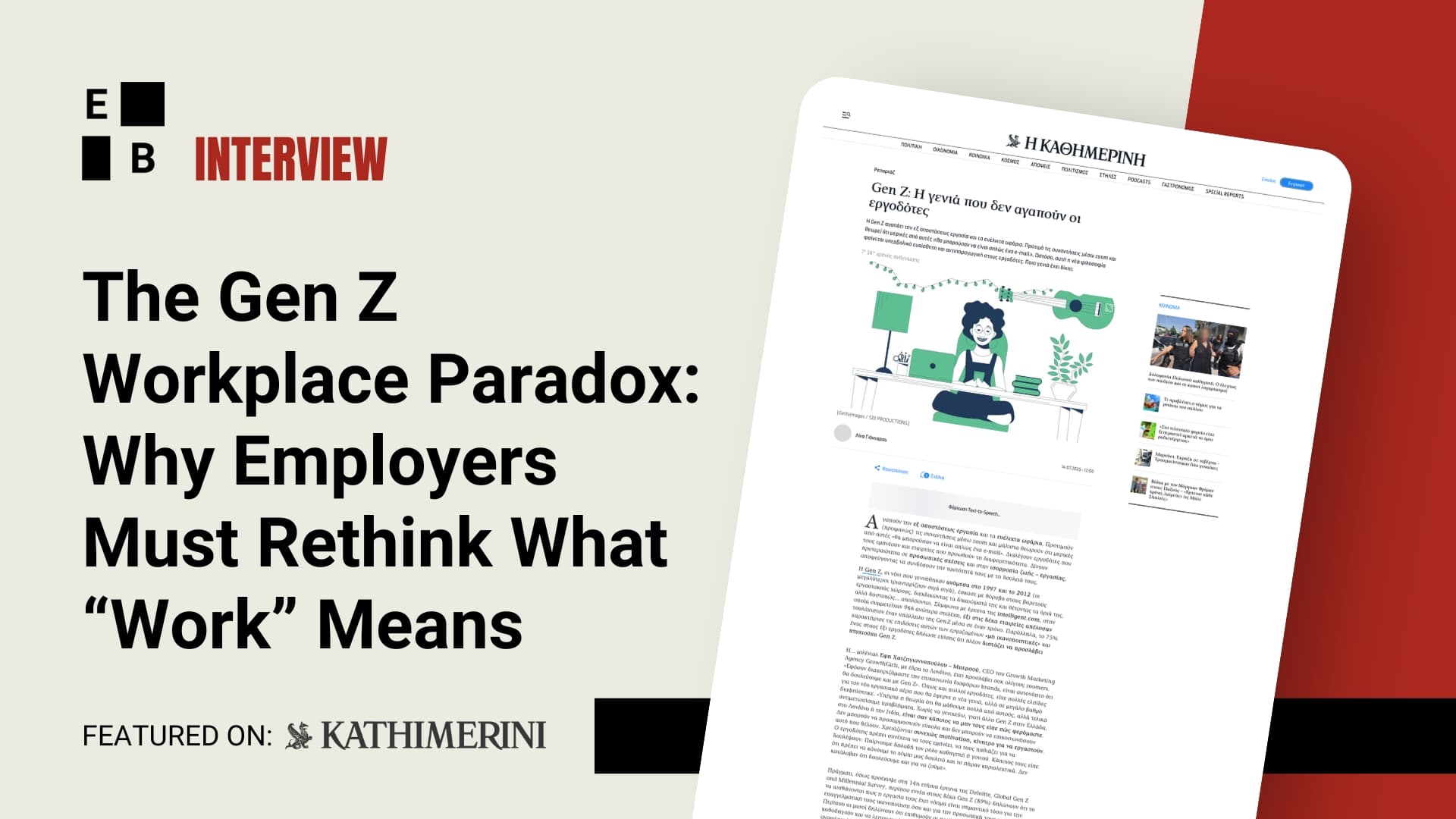
They’re not lazy. They’re just done with systems that don’t make sense anymore.
When Kathimerini recently explored why many employers “don’t love” Gen Z, it hit a nerve. Because behind the stereotypes and frustrations lies a deeper story, one that reveals how dramatically the idea of work has changed.
Gen Z grew up in a hyper-connected world, one where work is something you do, not somewhere you go.
They value flexibility, diversity, and mental health, preferring remote or hybrid models that give them freedom and focus. For them, productivity isn’t measured by how long you sit at a desk but by the impact you create.
Many leaders still see this mindset as defiance. In reality, it’s adaptation to a digital era that rewards creativity, not presence. When young professionals say “this meeting could’ve been an email,” they’re not being difficult, they are protecting time and energy for meaningful work.
This shift challenges companies to re-evaluate what truly drives results: output, trust, and purpose.
For many employers, Gen Z employees can feel like a mystery. They’re ambitious but selective, talented yet restless. They want feedback, but they also want freedom. It’s easy to label this behavior as “entitled”, but that label misses the point. What we’re seeing isn’t a lack of work ethic. It’s a cultural mismatch between traditional leadership models and the expectations of a new kind of workforce.
In my experience building global teams at GrowthGirls, I’ve learned that Gen Z doesn’t reject work, they reject outdated systems. They don’t respond to authority by hierarchy, but to authenticity through empathy. When leaders expect compliance instead of curiosity, they lose the chance to build real connection.
One of the biggest gaps in today’s workplace isn’t digital, it’s emotional.
Many Gen Z professionals crave guidance, not supervision. They want mentors who can help them translate potential into performance. According to Deloitte, over half of them say their managers rarely play that role.
That gap doesn’t mean they’re difficult to manage, it means they were raised in a feedback-rich, coaching-oriented world, and they expect the same at work. When we step into that space as leaders, we don’t just “teach”, we model growth.
Traditional management was built on visibility, if you could see people working, you could trust the outcome. But in hybrid and remote environments, that logic collapses.
For Gen Z, trust isn’t earned through presence -it’s built through communication, clarity, and consistency. They want to understand why something matters, not just what to do. Leaders who communicate context and empower ownership build teams that deliver more, even from afar.
It’s time to trade micromanagement for mentorship and control for connection.
Because when people feel seen, they no longer need to be watched.
If there’s one thing that defines Gen Z employees, it’s their refusal to separate success from wellbeing. They’ve seen the burnout of previous generations, the 60-hour workweeks, the “always-on” culture and they’ve decided to write a new playbook.
According to Deloitte’s Global Gen Z and Millennial Survey, nearly nine out of ten Gen Z professionals say that purpose is essential to their satisfaction and mental health. To them, a job isn’t just a paycheck, it’s a reflection of their values. When meaning disappears, motivation follows.
As leaders, we can either fight that shift or learn from it. Because what Gen Z is teaching us is not about fragility, it’s about focus.
For decades, we’ve measured success by metrics: output, hours, performance reviews. But purpose changes the equation. When employees understand the why behind their work, they don’t need external motivation, they self-activate.
A purpose-driven environment doesn’t mean lowering expectations. It means aligning goals with meaning, so people perform better because they care more deeply.
Modern leadership isn’t about squeezing results from people.
It’s about designing systems that make fulfillment productive.
Mental health and performance aren’t competing forces, they’re connected systems.
When people feel psychologically safe, creativity flourishes. When they’re supported, they take risks. When they’re trusted, they grow.
This requires a leadership shift: from checking boxes to checking in.
We need to normalize conversations about burnout, emotional load, and workload design, not as “benefits,” but as business imperatives.
Because a healthy team isn’t a luxury.
It’s a growth strategy.
For years, the idea of a four-day work week sounded like a utopian dream, until countries like Iceland, the U.K., and New Zealand proved it could actually work.
After Iceland’s pilot, 90 % of the workforce adopted shorter hours with no loss in productivity. Stress levels dropped, equality improved, and overall job satisfaction rose dramatically.
To many Gen Z employees, this isn’t radical, it’s logical. They’re not asking to work less; they’re asking to work smarter, in ways that protect focus, creativity, and mental health.
When a generation raised on data sees evidence that wellbeing and results can coexist, they expect leadership to evolve accordingly. The question isn’t “Can we afford flexibility?”, it’s “Can we afford burnout?”
Studies across six countries show a clear pattern: reduced working hours lead to fewer sick days, higher engagement, and greater innovation.
The model known as 100-80-100 (100 % pay, 80 % time, 100 % productivity), demonstrates that balanced schedules don’t hinder performance; they enhance it.
For Gen Z, these insights validate what they’ve been saying all along: rest fuels results.
And for leaders, it’s proof that modern productivity is no longer about time spent, but about energy applied.
The next generation won’t settle for workplaces that measure value in exhaustion. They seek environments that combine trust, autonomy, and wellbeing and they’ll move on quickly from those that don’t.
Forward-thinking organizations are already experimenting with flexible schedules, AI-assisted workflows, and outcome-based metrics. These aren’t “perks”; they’re strategic levers for attracting and retaining talent.
Because when teams are rested and respected, growth becomes sustainable.
Understanding Gen Z isn’t about lowering expectations, it’s about raising the standard for leadership.
The new generation doesn’t want to be managed; they want to be mentored. They don’t follow titles; they follow trust.
If we want to attract and retain top talent in this new era, we must stop clinging to the past and start designing workplaces that inspire ownership, creativity, and purpose.
Lead with empathy.
Be the example of the culture you want to see. Emotional intelligence is the new leadership KPI.
True leadership today is about creating the conditions for autonomy and accountability to coexist.
It means trusting people enough to let them surprise you, and supporting them enough so they can.
The best leaders I know don’t just talk about growth; they design it through systems, culture, and human connection.
When we give people the safety to fail and the permission to grow, they don’t just perform better.
They help build companies that last.
Every generation has challenged the one before it but what’s happening with Gen Z is more than a generational clash. It’s a paradigm shift.
Baby Boomers built stability.
Gen X brought pragmatism.
Millennials championed innovation.
And now, Gen Z brings consciousness, a demand for meaning, transparency, and psychological safety.
They’re not trying to destroy the system; they’re simply asking why it still runs the way it does.
And maybe that’s exactly the question leaders should be asking too.
Conscious leadership is about awareness: of self, of others, and of the systems we create. It means balancing profit with purpose, growth with wellbeing, and speed with sustainability.
Leaders who practice consciousness don’t fear feedback. They invite it.
They see culture as an ecosystem: one that needs care, not control.
In this new era, the most successful companies won’t be the ones that adapt to Gen Z, but the ones that evolve with them, co-creating workplaces where every generation thrives.
Gen Z isn’t the generation employers don’t love.
They’re the mirror showing us how fast the world is changing and how urgently leadership must evolve with it.
If we want to build organizations that grow, not just survive,
we need to stop teaching employees how to fit into the past and start designing futures worth belonging to.
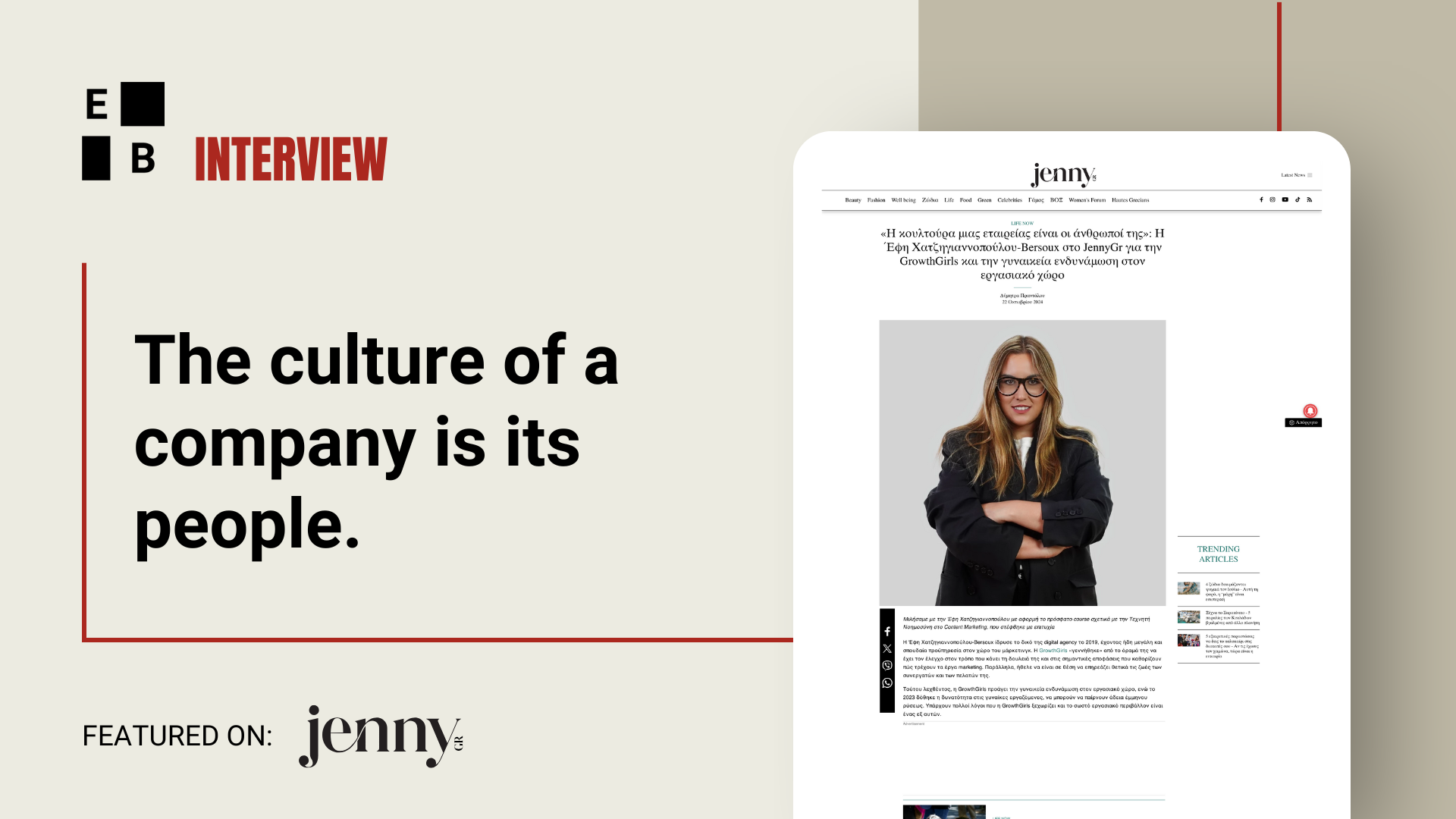
This article was inspired by my interview and reflections featured in Kathimerini’s piece, “Gen Z: The Generation Employers Don’t Love.”
The conversation sparked important questions about leadership, culture, and how we can bridge generational gaps at work.

| Cookie | Duration | Description |
|---|---|---|
| _ga | 2 years | The _ga cookie, installed by Google Analytics, calculates visitor, session and campaign data and also keeps track of site usage for the site's analytics report. The cookie stores information anonymously and assigns a randomly generated number to recognize unique visitors. |
| _gat_UA-145844356-1 | 1 minute | A variation of the _gat cookie set by Google Analytics and Google Tag Manager to allow website owners to track visitor behaviour and measure site performance. The pattern element in the name contains the unique identity number of the account or website it relates to. |
| _gid | 1 day | Installed by Google Analytics, _gid cookie stores information on how visitors use a website, while also creating an analytics report of the website's performance. Some of the data that are collected include the number of visitors, their source, and the pages they visit anonymously. |
| cookielawinfo-checkbox-advertisement | 1 year | Set by the GDPR Cookie Consent plugin, this cookie is used to record the user consent for the cookies in the "Advertisement" category . |
| cookielawinfo-checkbox-analytics | 11 months | This cookie is set by GDPR Cookie Consent plugin. The cookie is used to store the user consent for the cookies in the category "Analytics". |
| cookielawinfo-checkbox-functional | 11 months | The cookie is set by GDPR cookie consent to record the user consent for the cookies in the category "Functional". |
| cookielawinfo-checkbox-necessary | 11 months | This cookie is set by GDPR Cookie Consent plugin. The cookies is used to store the user consent for the cookies in the category "Necessary". |
| cookielawinfo-checkbox-others | 11 months | This cookie is set by GDPR Cookie Consent plugin. The cookie is used to store the user consent for the cookies in the category "Other. |
| cookielawinfo-checkbox-performance | 11 months | This cookie is set by GDPR Cookie Consent plugin. The cookie is used to store the user consent for the cookies in the category "Performance". |
| CookieLawInfoConsent | 1 year | Records the default button state of the corresponding category & the status of CCPA. It works only in coordination with the primary cookie. |
| elementor | never | This cookie is used by the website's WordPress theme. It allows the website owner to implement or change the website's content in real-time. |
| viewed_cookie_policy | 11 months | The cookie is set by the GDPR Cookie Consent plugin and is used to store whether or not user has consented to the use of cookies. It does not store any personal data. |
| Cookie | Duration | Description |
|---|---|---|
| _gr | 2 years | |
| _gr_flag | 2 years |