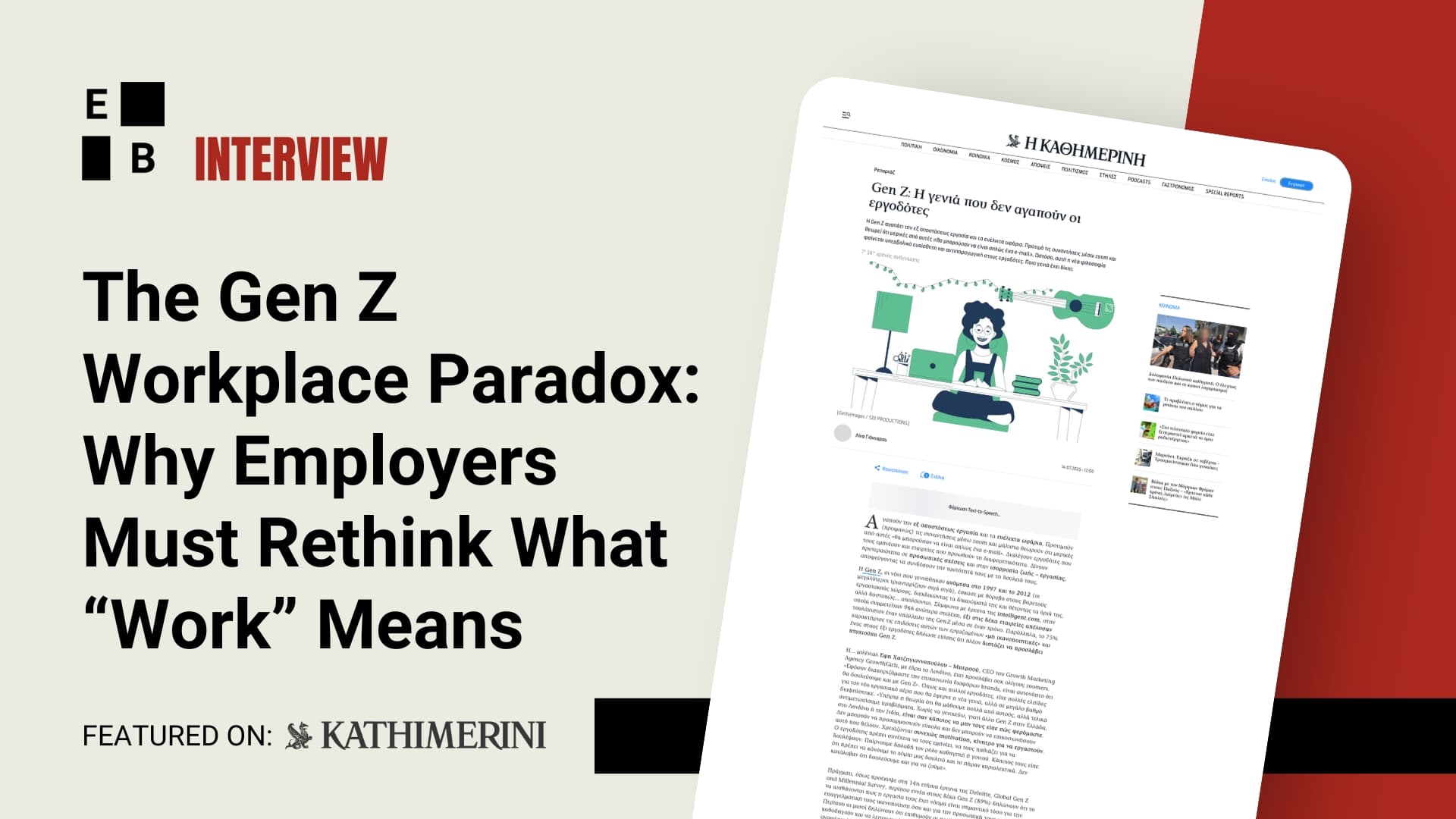
The Gen Z Workplace Paradox: Why Employers Must Rethink What “Work” Means
Gen Z isn’t lazy, they’re redefining work. Effie Bersoux explores how leaders can adapt with empathy, purpose, and conscious leadership.

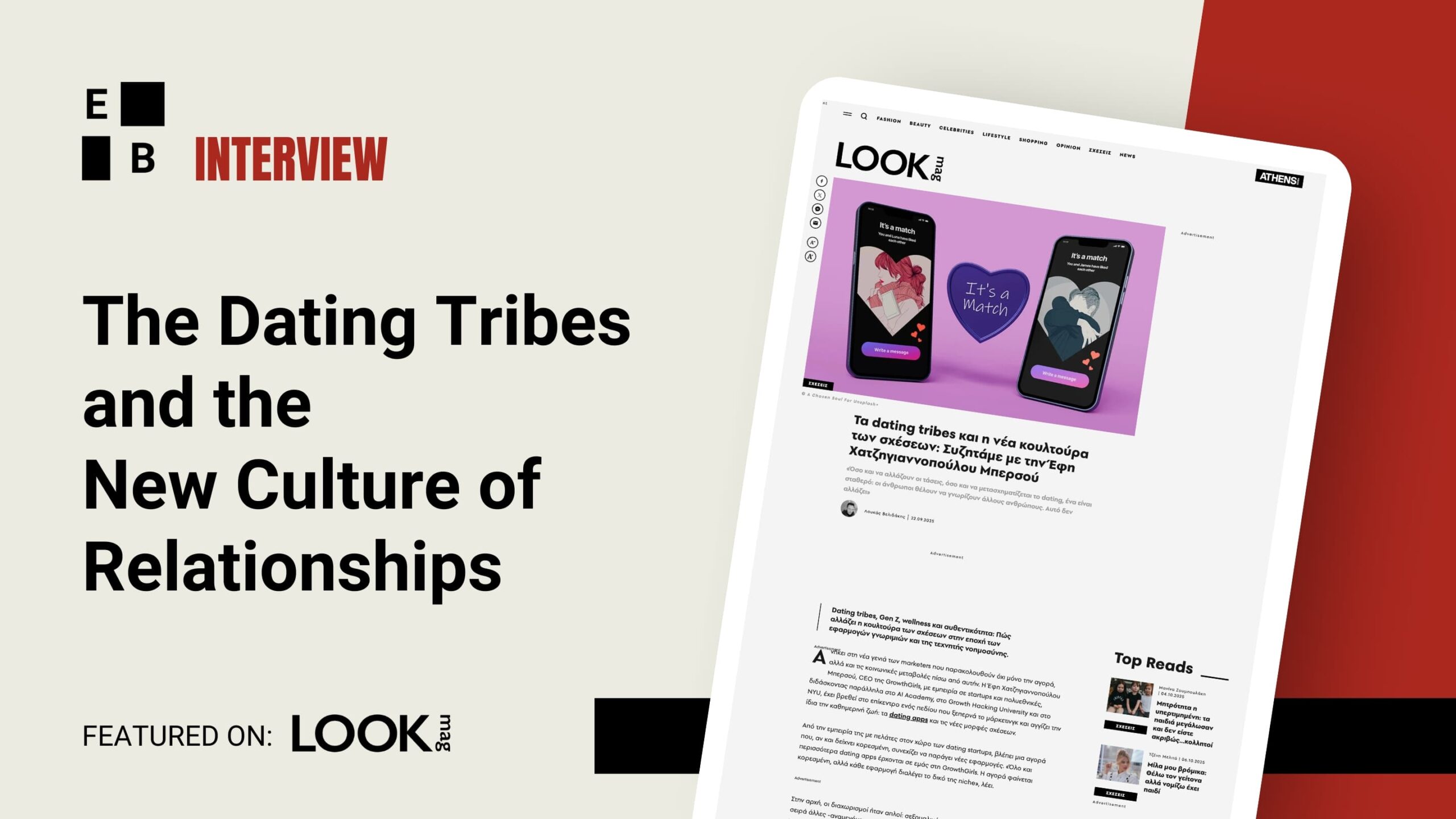
Interview with Effie Chatzigiannopoulou Bersoux
“No matter how trends change or how dating evolves, one thing remains constant: people want to meet other people. That never changes.”
Dating tribes, Gen Z, wellness, and authenticity: how the culture of relationships is being redefined in the age of dating apps and artificial intelligence.
She belongs to a new generation of marketers who observe not only the market but also the social shifts behind it.
Effie Chatzigiannopoulou Bersoux, CEO of GrowthGirls, with experience in startups and multinational companies, and teaching at the AI Academy, Growth Hacking University, and NYU, has found herself at the intersection of a field that extends far beyond marketing and into everyday life itself: dating apps and the new forms of relationships.
From her experience working with clients in the dating startup space, she sees a market that, although seemingly saturated, continues to generate new applications.
“More and more dating apps approach us at GrowthGirls. The market looks saturated, but each app finds its own niche,” she says.
In the beginning, the distinctions were simple: sexual orientation, age, and a few expected categories.
Over time, the criteria became more complex: political beliefs, religion, lifestyle choices, even everyday habits.
“There are apps just for dog owners, or for people who wake up at five in the morning to go jogging. Everyone is looking for their tribe,” Effie notes.
The logic of tribes isn’t new; people have always sought similarities to build relationships.
What has changed is the level of specialization and the technological mediation.
“When you declare what you like, the app starts showing you the same kind of people again and again. It creates echo chambers: you find your look-alikes, exclude everyone else, and your horizons stop expanding,” she observes.
This segmentation of preferences leads to smaller, closed communities, with lifestyle defining the range of options: from vegans who only want to meet other vegans, to fitness enthusiasts unwilling to share their life with someone who doesn’t follow the same routine.
As fragmentation grows, more apps appear, often spin-off products aimed at increasingly specialized audiences.
That’s where the market stands today.
Tinder, Bumble and Hinge remain the most recognizable names, but their user base is declining, mainly among Gen Z, while millennials and older users continue to engage with them in familiar ways.
“Younger generations don’t like using them. They reject the hook-up culture,” Effie explains.
“Gen Z rejects labels. They don’t want to declare whether they are straight, gay, bi, or pansexual. They want to be themselves, to express authenticity without being boxed in.”
At the same time, they’re not interested in heavily curated images.
“They don’t care for perfect filters or posed photos, they care about the feeling of something real.”
It’s a generation that grew up with Instagram but uses it more casually, partly as a reaction to the perfectionism of the previous decade.
The conversation around dating can’t be separated from broader social trends.
The pandemic produced a generation that came of age during lockdowns, with limited in-person socialization and greater familiarity with online connection.
This generation drinks less alcohol, goes out less to bars, and prefers new forms of socializing: morning events with music and juice bars, wellness retreats and collective experiences not centered on nightlife or alcohol.
The turn toward wellness cuts across generations.
“Millennial women go to wellness or quiet resorts where no one even speaks. Once, vacations meant fun and parties. Now, that’s changing,” Effie says.
As a result, wellness becomes a new identity, a new tribe, shaping even romantic choices.
This shift aligns with research showing a decrease in sexual activity among younger generations.
“Gen Z has less sex compared to millennials at the same age,” Effie notes.
Some attribute this to neo-puritanism, others to a shift in interests.
“They have so many things to explore: travel, experiences, self-discovery. Sex isn’t the only priority anymore. Priorities are becoming more mental,” she adds.
So, has dating become too marketized, losing its authenticity?
“We often think authenticity is meeting your classmate and falling in love. But maybe it’s just as authentic to have endless options: people from other countries, cultures, and perspectives. Personally, I lean toward the latter.”
With dating apps, the randomness of flirting at a bar is replaced by the artificial randomness of algorithms.
“If you used to meet someone from your neighborhood, your political group, or your church, today you might find yourself talking to someone from another country, another religion, a completely different background. The pool of options has widened, even if the process feels less romantic.”
In marketing terms, algorithms function through patterns.
“We’re not interested in the individual, we’re interested in the group. That’s how we identify patterns, and that’s how companies grow.”
Algorithms detect behaviors and offer users what they’re most likely looking for.
Inevitably, the discussion leads to artificial intelligence, now present on both sides:
“Tinder, for example, now asks you if you’re sure you want to send something offensive. With its pros and cons, the environment becomes more sanitized,” Effie explains.
Flirting freedom may shrink, but incidents of harassment decrease.
It’s a balance with both positive and negative effects.
Looking ahead, Effie sees a double movement:
On one side, cynicism: relationships becoming more instrumental and pragmatic.
On the other, a rise in romanticism: a desire for deeper emotional connection.
The coexistence of these two tendencies shows how social and multifaceted the phenomenon really is.
“No matter how trends change or how dating evolves, one thing remains constant: people want to meet other people. That doesn’t change,” she concludes.
Originally published in LOOK Mag

| Cookie | Duration | Description |
|---|---|---|
| _ga | 2 years | The _ga cookie, installed by Google Analytics, calculates visitor, session and campaign data and also keeps track of site usage for the site's analytics report. The cookie stores information anonymously and assigns a randomly generated number to recognize unique visitors. |
| _gat_UA-145844356-1 | 1 minute | A variation of the _gat cookie set by Google Analytics and Google Tag Manager to allow website owners to track visitor behaviour and measure site performance. The pattern element in the name contains the unique identity number of the account or website it relates to. |
| _gid | 1 day | Installed by Google Analytics, _gid cookie stores information on how visitors use a website, while also creating an analytics report of the website's performance. Some of the data that are collected include the number of visitors, their source, and the pages they visit anonymously. |
| cookielawinfo-checkbox-advertisement | 1 year | Set by the GDPR Cookie Consent plugin, this cookie is used to record the user consent for the cookies in the "Advertisement" category . |
| cookielawinfo-checkbox-analytics | 11 months | This cookie is set by GDPR Cookie Consent plugin. The cookie is used to store the user consent for the cookies in the category "Analytics". |
| cookielawinfo-checkbox-functional | 11 months | The cookie is set by GDPR cookie consent to record the user consent for the cookies in the category "Functional". |
| cookielawinfo-checkbox-necessary | 11 months | This cookie is set by GDPR Cookie Consent plugin. The cookies is used to store the user consent for the cookies in the category "Necessary". |
| cookielawinfo-checkbox-others | 11 months | This cookie is set by GDPR Cookie Consent plugin. The cookie is used to store the user consent for the cookies in the category "Other. |
| cookielawinfo-checkbox-performance | 11 months | This cookie is set by GDPR Cookie Consent plugin. The cookie is used to store the user consent for the cookies in the category "Performance". |
| CookieLawInfoConsent | 1 year | Records the default button state of the corresponding category & the status of CCPA. It works only in coordination with the primary cookie. |
| elementor | never | This cookie is used by the website's WordPress theme. It allows the website owner to implement or change the website's content in real-time. |
| viewed_cookie_policy | 11 months | The cookie is set by the GDPR Cookie Consent plugin and is used to store whether or not user has consented to the use of cookies. It does not store any personal data. |
| Cookie | Duration | Description |
|---|---|---|
| _gr | 2 years | |
| _gr_flag | 2 years |